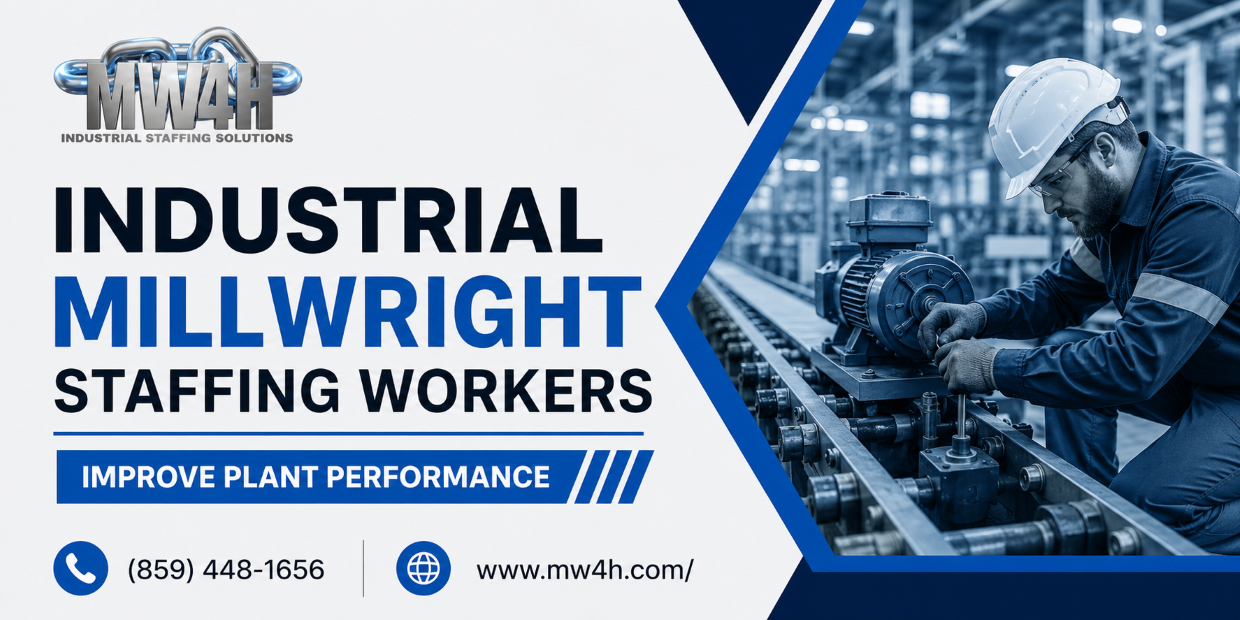
Industrial Millwright staffing workers are one of the most underrated contributors to plant performance in manufacturing today. Most plant managers chase equipment upgrades or software solutions when operations slow down, but the real answer is usually simpler: the wrong people are maintaining the machinery.
This blog explains exactly how skilled millwright staffing directly improves plant performance, reduces downtime, and saves money over the long term.
When a plant runs poorly, the instinct is to blame the equipment. But machinery does not fail in a vacuum. It fails because warning signs were missed, maintenance was delayed, or a breakdown happened and nobody nearby had the knowledge to fix it quickly.
Facilities that rely on generalist maintenance crews to cover every system create invisible gaps in coverage. A technician skilled in electrical work or HVAC might be completely competent at their job and still have no feel for a conveyor belt tracking problem or a misaligned shaft. That knowledge gap is where small problems quietly grow into expensive shutdowns.
This is where Industrial Millwright staffing workers create a measurable difference. They bring years of system-specific experience that cannot be improvised in the moment. They know what early failure looks like. They know what to check first. That knowledge saves hours during a breakdown and prevents many breakdowns from ever happening.
A millwright is not a generalist. They are a trade-certified industrial mechanic trained specifically in the installation, alignment, troubleshooting, and repair of industrial machinery. What separates them from general maintenance staff comes down to three things.
Mechanical Intuition Built Over Years An experienced millwright listens to equipment. They feel vibration through their hands. They notice a motor running slightly hotter than normal, a belt tracking a few millimeters off, or a coupling developing play. These are things that only become visible to someone who has spent years working on the same category of equipment. For a generalist, these signals are background noise. For a millwright, they are action items.
Precision Alignment and Installation Skills One of the biggest hidden causes of poor plant performance is misalignment. Shafts running even slightly out of true cause vibration, accelerate bearing wear, shorten seal life, and waste energy. A qualified millwright does not install equipment by feel. They use precision measurement tools and verify alignment before anything goes back into service. That rigor, applied consistently, extends equipment life significantly.
Fast and Accurate Breakdown Response Because skilled millwrights have seen the same failure modes before, they diagnose problems faster and make fewer wrong turns during repairs. A breakdown that takes a generalist crew six hours to resolve might take a millwright one or two. At $50,000 to $250,000 per hour of unplanned downtime, that speed difference has a very real dollar value.
The biggest performance gain from skilled millwright staffing is not what happens during a breakdown. It is what happens before one. A qualified millwright running a genuine preventive maintenance program does the following on a regular basis:
Each of these tasks requires someone who genuinely knows the equipment they are working on. Without that knowledge, preventive maintenance becomes a checkbox exercise. Forms get filled, and failures happen anyway on their own schedule.
With the right person doing the work, preventive maintenance actually prevents things. That is the difference between a plant that is always fighting fires and one that runs predictably, quarter after quarter.
The math here is straightforward once you use the right inputs.
A specialized millwright costs more per hour than a general maintenance technician. That is true. But that comparison ignores the cost of the downtime being prevented, the equipment life being extended, and the repeat failures being stopped before they compound.
Consider a single unplanned conveyor shutdown that takes a generalist crew eight hours to resolve versus two hours for a qualified millwright. At a conservative $100,000 per hour of downtime, the six-hour difference is worth $600,000 on that one incident alone. The annual cost of a dedicated millwright is typically less than that.
When you add in the value of equipment that lasts longer, energy costs reduced through proper alignment, and maintenance budgets that stop rising year over year, the investment in skilled millwright staffing pays for itself clearly and repeatedly.
Most plants are not doing this math. They are comparing wage rates and missing the point entirely.
One concern that comes up often is whether specialized staffing means committing to a fixed headcount regardless of production levels. It does not have to.
At Millwrights4Hire, engagements are structured to match operational reality. Plants with seasonal peaks can scale coverage up during high-demand periods and pull back during slower windows. Facilities with planned shutdown windows can bring in a dedicated project team to work through comprehensive inspections and repairs in a compressed timeframe, then return to leaner ongoing coverage.
This flexibility matters particularly for shutdown maintenance, which is one of the highest-leverage activities in any plant's calendar. A well-executed shutdown staffed with qualified millwrights, who move through equipment systematically and complete the repairs and alignments that cannot be done during live production, is what funds months of reliable operation afterward. The quality of that work depends entirely on the expertise of the people doing it.
There is a dimension to millwright staffing that does not show up in any spreadsheet but that every experienced plant manager understands: the value of someone who truly knows your specific equipment.
A millwright who has worked in your facility for six months knows things no outside technician can know. They know which motor runs hotter than the one next to it and why. They know the history of repairs on every major system and what to watch for as a result. They know the quirks your equipment has developed over years of service.
That knowledge is protective. When something starts behaving differently, a millwright with that context catches it earlier and responds more accurately. Early warnings that a newcomer might dismiss get acted on appropriately. That institutional knowledge compounds over time and is genuinely difficult to replace once it exists.
Industrial Millwright staffing workers placed through Millwrights4Hire are selected with this long-term fit in mind. The goal is not to fill an open position. It is to build the kind of sustained expertise that makes a plant progressively more reliable year over year.
Not every staffing provider understands the mechanical trades well enough to make genuinely useful placements. Many general industrial staffing agencies do not have the knowledge to distinguish between a millwright whose background fits your application and one who is credentialed but mismatched in experience.
That distinction matters. A plant running heavy mineral processing equipment needs different instincts and experience than one running high-speed packaging lines. Both require millwrights. The right millwright for each environment is not the same person.
When evaluating a staffing partner, ask how they screen for relevant industry-specific experience. Ask whether they can explain the difference between what your application requires and what a general millwright brings. Ask whether they maintain relationships with placed workers and have a process for identifying fit issues early. Those questions quickly separate providers who understand the work from those who process resumes.
Downtime is not inevitable. A significant portion of what plants accept as normal, the recurring breakdowns, the extended recoveries, the maintenance backlogs, is preventable with the right people in the right roles.
Industrial Millwright staffing workers are one of the most direct investments a facility can make in its own operational reliability. The plants that understand this run cleaner, recover faster, and consistently outperform those that do not.
If your plant is dealing with recurring equipment issues, recovery times that stretch longer than they should, or a maintenance program that always feels like it is one breakdown behind, the answer is probably not a new system or a new process. It is getting the right skilled person through the door and letting them do what they are trained to do.
Everything you need to know about our Industrial Millwright staffing services.


































Reach out for staffing solutions or inquiries. We are here to assist you with your needs across various industries.